


MEDICALLY REVIEWED BY

Shelly Umstot, BSN, RN
Shelly Umstot is a BSN and has been a registered nurse for over 35 years. She lives in North East Ohio and is a freelance health content writer. Her passion is bringing understanding to those with questions and concerns regarding health issues and helping them obtain and maintain their optimal health. She loves being with her family and has two lovely granddaughters who have stolen her heart. Assisting new parents in finding the information they need to face the joys and challenges of caring for their children is a gratifying experience for her as a professional, parent, and grandparent herself.
Pregnancy hip pain is a very common occurrence, but it is not a one-size-fits-all type of pain: the pressure point, the lack of support, and the remedy are all unique from person to person. If you want to use a pregnancy pillow to alleviate hip pain, begin by checking the area between more than your knees. Support from the knee to the ankle towards the top leg; do not let the top knee move too far forward, and support with the belly or back only when the gaps are pulling your pelvis out of good position.
Once you know what is missing in your comfort when sleeping, you can take a look at some Momcozy pregnancy pillows and compare the targeted and full-body selections. This guide is for hip support troubleshooting; for shape-by-shape placement and first-night setup, refer to the guide to pregnancy pillow positions.
While a pregnancy pillow can offer a little extra support and comfort, it should not be used as a diagnostic tool to determine the cause of the hip pain, nor should it be a substitute for the advice from a professional if the pain is severe, chronic, worsening, or otherwise concerning.
Key Takeaways
Hip support usually starts between the knees, but the setup may also need to extend toward the ankles, under the belly, or lightly behind the back. Adjust one point at a time rather than assuming a bigger pillow automatically solves the problem.
- Locate the pressure before choosing a pillow shape: bottom hip, top hip, back, or belly each point to a different fix.
- Look to see if knee support extends to the ankles, rather than stopping at the knees.
- Do not allow the top knee to move too far forward, which pulls the pelvis out of a comfortable position.
- Treat bottom-hip pressure, belly pull, and lower-back discomfort as separate checks, not one problem.
- Use a pillow as a support tool, not a treatment.
Where Is the Hip Pressure
Hip pain isn't one sensation. Separating bottom-hip pressure from outer-hip discomfort, hip-plus-back pain, and hip-plus-belly pulling helps you know which setup to test first.
|
What You Notice |
What to Test |
|
The side touching the mattress feels sore first |
A slight supported lean instead of lying fully flat on that hip |
|
The top leg drops forward or hangs unsupported |
Support running from the knee toward the ankle, not just between the knees |
|
The torso needs light contact behind the back |
A thin pillow or folded blanket for gentle back support |
|
The belly feels heavy or pulls you forward |
A wedge or extra fill tucked under the bump |
Pain location doesn't tell you the underlying cause; it only tells you which part of the support chain to check next.
How the Hip Support Chain Works

Many people start by placing a pillow between the knees and stop there. While this is a good place to begin, it only accounts for one part of the chain: pressure on the knees, ankles, pelvis, belly, and back all contribute to how much pressure the hip will have to carry.
Knees. Support between the knees creates space so the top leg doesn't rest directly on the bottom leg.
Ankles and lower legs. Support that stops at the knees can leave the lower leg to hang or rotate forward, which pulls the pelvis with it.
Pelvis. The goal is a stable resting position, not a specific angle.
Belly. As the belly grows, an unsupported gap can pull the torso forward, changing how weight sits on the hip.
Back. A small amount of contact behind the back can help some people hold a comfortable side-lying position, though this isn't necessary for everyone.
How to Position a Pregnancy Pillow for Hip Support
Once you know where the pressure chain needs support, here's a repeatable setup to test, whether you're using a pregnancy pillow, a knee pillow, a wedge, or just a couple of regular pillows.
- Start on either comfortable side. Side sleeping is generally recommended during pregnancy, and either side works if it's supported well.
- Place support between the knees, then check the ankles. A pillow between the knees is the usual starting point; if the lower leg still hangs or rotates forward, extend support toward the ankle.
- Bring the top knee back. If it's drifted into an exaggerated forward position, gently guide it back in line with the bottom knee.
- Fill the belly gap without lifting or compressing it. Slide part of the pillow under the bump so it's supported, without wedging it up too high.
- Add light back support if a slight lean feels better. Not necessary for everyone, but a thin pillow behind the back can help.
- Turn once and repeat the checks on the other side. A setup that works on one side may need small adjustments after you turn.
The goal isn't a single "correct" position on the first try. Small adjustments, tested one at a time, usually matter more than pillow shape itself.
Knees Only or Full Leg Support
A knee pillow may be enough on its own, and there's no need to upgrade if it's already working. It becomes worth extending toward the ankles when the top leg still hangs, drifts forward, or the setup shifts after you turn.
|
No Pillow |
Knees Only |
Knees Plus Ankles |
|
Top leg rests directly on the bottom leg |
Space is created between the knees, but the lower leg may still hang or rotate forward |
The top leg is supported along its length, reducing forward drift |
|
Hips more likely to feel uneven pressure |
An improvement for many, but not a full fix for everyone |
Often the setup people land on when a knee pillow alone hasn't been enough |
A few things to check regardless of setup:
- Support the top leg along its length, not just at one point.
- Avoid forcing the knees too far apart; a comfortable gap is enough.
- Retest after turning, since a setup that worked on one side may not transfer.
- A regular body pillow may be enough for full-leg support if it's the right length.
Why the Hip Touching the Mattress May Still Hurt

If the hip against the mattress is the main pressure point, a thicker knee pillow may not be the fix, since the issue isn't leg spacing. Two things are worth testing instead: a slight supported lean, and the mattress itself.
Fully vertical side-lying puts more direct weight on the bottom hip. A slight backward lean, supported lightly behind the back, can shift some of that weight off while keeping you comfortably side-lying. Keep the lean light: the goal is a small shift, not a new position.
Check whether the belly is pulling the torso forward, and keep in mind the mattress or topper is part of the pressure experience too; a pillow can't fully offset a very firm surface.
If lower-back support turns out to be the main unresolved piece, the guide to using a pregnancy pillow for back pain walks through that setup specifically.
Why Your Hips May Still Hurt with a Pregnancy Pillow
A pregnancy pillow that still isn't solving the problem is usually missing one variable, not failing outright. Change one thing at a time and retest before adding another product.
- Knees supported, ankles and lower legs not. Try this: extend support toward the ankle, or switch to a longer pillow.
- Top knee too far forward. Try this: gently guide it back in line with the bottom knee each time you settle in.
- Belly gap left open. Try this: tuck part of the pillow under the bump.
- No light back contact when a lean would feel better. Try this: add a thin pillow behind the back.
- Pillow makes turning or exiting bed impractical. Try this: consider a smaller or more open setup.
- Every pressure problem gets blamed on pillow shape. Try this: rule out the mattress or unrelated discomfort first.
These are setup issues, not causes of the underlying pain. If you've worked through all six and pressure is still significant, bring it up with your care provider rather than continuing to swap products.
When Regular Pillows Are Enough
A dedicated pregnancy pillow isn't a requirement. A regular knee or body pillow may be enough when one support point stays stable and turning remains easy.
|
Regular or Knee Pillow |
Pregnancy Pillow |
|
|
Best fit |
One stable support need |
Several support points at once |
|
Main advantage |
Familiar, flexible, easy to turn with |
Stays in place across multiple gaps |
|
Main trade-off |
May shift after turning |
Uses more bed space |
|
Upgrade trigger |
No upgrade needed if comfortable |
Consider when separate pillows keep moving |
A dedicated pillow adds value through stability and coverage, not because it's labeled for pregnancy. The setup that stays simplest while still working is usually the one worth keeping.
Targeted or Multi Point Support
Once you know which support points you're missing, the amount of coverage you need follows from that, not from which pillow is rated "best."
|
Regular or Knee Pillow |
Wedge or Compact Support |
Long Body or J-Shaped |
U-Shaped |
|
|
Best fit |
One leg-spacing task |
One belly or back gap |
Full-leg support with an open side |
Two-sided multi-point support |
|
Main advantage |
Familiar, flexible, easy to turn with |
Uses less surrounding space |
Supports knees toward ankles without a full wrap |
Supports both sides after turning |
|
Main trade-off |
May shift or leave the lower leg unsupported |
Limited coverage, may need repositioning |
May require repositioning when switching sides |
Uses more bed space and may feel warmer or more restrictive |
|
Upgrade trigger |
No upgrade needed if comfortable |
Choose when one gap needs filling |
Choose when full-leg support is the main need |
Choose when several points and both sides need coverage |
A U-shaped pregnancy pillow is one example of two-sided, multi-point coverage: belly, back, and legs supported on either side without rebuilding after you turn. It isn't the right fit for everyone, since it takes more space and can run warm, but it's worth considering once several support points, not just one, are the issue.
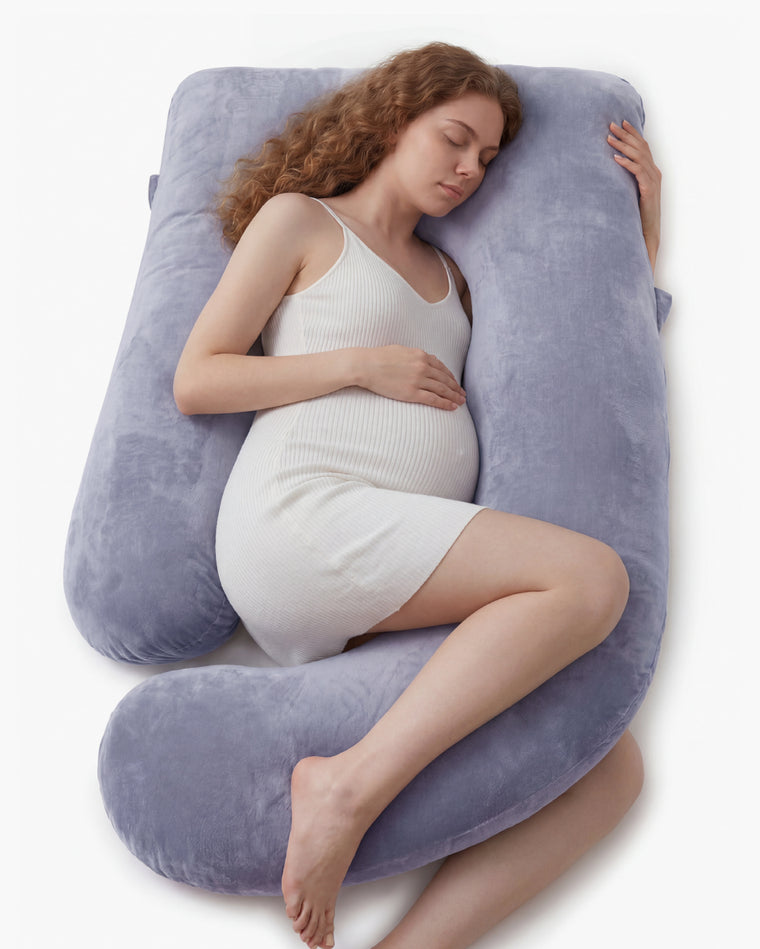
Heat, Bed Space, and Turning
A setup isn't useful if it's too warm to sleep in or impractical to move around in. Run this quick test for any option you're considering:
- Left side, then right side: does the support hold on both?
- Sitting up: can you do it without fully dismantling the pillow?
- Getting out of bed: manageable for late-night trips?
- Sharing the bed: does a partner still have usable space?
Also measure the pillow's dimensions against your mattress width before assuming it's compact, and distinguish cool-to-touch fabric from general breathability and filling; they aren't the same thing.
If U-shaped coverage fits but you sleep warm, a cooling U-shaped pregnancy pillow is worth evaluating for fabric feel specifically, separate from the support question.

When a Pillow Is Not Enough

A pillow can support your positioning and comfort, but it can't identify or resolve the underlying cause of hip pain. If you've worked through the checks above and discomfort is severe, persistent, worsening, or starting to affect daily activities, loop in your doctor, OB, midwife, or physical therapist rather than continuing to try new setups.
Don't force a position that feels worse just because it's the "recommended" one. Go back to the smallest setup that's still comfortable while you get guidance suited to your situation.
Frequently Asked Questions
Do pregnancy pillows help with hip pain?
They don't identify the underlying cause, so if pain is intensifying or becoming more frequent, it's worth talking to your care provider.
Where should I place a pillow for hip support during pregnancy?
Add belly support if the bump is pulling you forward, and light back support if a slight lean feels more comfortable.
Why do my hips still hurt with a pillow between my knees?
Knee support alone doesn't address the whole chain. See if the lower leg is not supported, the top knee is drifting forward, or the hip against the mattress is the pressure point.
Should the pillow support my ankles as well as my knees?
If your lower leg hangs forward or rotates forward, it can help. Try extending support towards the ankle and check if the top leg feels more stable.
What is the best pregnancy pillow for hip pain?
There isn't one universal answer; it depends on which support points you're missing and how much bed space and turning ease you need. A knee pillow, wedge, or U-shaped pillow can each fit different situations.
Is a wedge or U-shaped pillow better for hip support?
A wedge targets one gap, like the belly or back, while a U-shaped pillow covers multiple points on both sides. Some combine both once they know which points matter most.
Can I use regular pillows instead of a pregnancy pillow?
Yes, if one support point stays stable and turning remains easy. A dedicated pillow becomes more useful when several supports shift at once.
What if the hip touching the mattress still hurts?
Try a slight supported lean instead of lying fully flat on that side, and check whether the belly is pulling your torso forward. The mattress itself may also be part of the pressure.
Conclusion
Start by locating where the pressure actually is, then support the top leg from the knee toward the ankle before adding belly or back support as needed. Adjust one point at a time; more coverage isn't automatically better.
A regular pillow is a complete answer for plenty of people. If you're ready to compare more structured options, the Momcozy pregnancy pillow collection covers targeted and full-body choices side by side. And if pain is severe, persistent, or worsening, that's a conversation for your doctor, OB, midwife, or physical therapist, not a pillow adjustment.


