Why does my nursing pillow keep sliding away? If you keep pulling the pillow back toward your waist during feeds, the cause is usually one of three things: the pillow’s size, your sitting position, or how the nursing pillow fastens to your body. Before you buy another one, take a moment to notice when and how it shifts.
Pay attention to what the whole pillow does. Does it drift away from you, leaving a gap between you and your baby? Or does it sink lower as the feed goes on? Each pattern points to a different fix, and spotting it helps you adjust things while keeping your baby well supported.
Tightening the strap or ordering a replacement may not solve the real problem, so identify the cause first.

Key Takeaways
- Frequent sliding may indicate that the pillow opening, caregiver fit, permitted attachment, or seated arrangement are incompatible. It’s not that too much firmness is the answer to everything.
- Before trying changing an adult attachment, check your particular pillow model and instructions. It fastens the pillow to you, never to the baby.
- If your pillow shifts away from your waist, that’s different from it becoming flatter. Notice what happens first before deciding what to check.
- Keep supporting your baby while feeding and whenever you adjust the setup. Avoid improvised belts or straps, loose materials to fill gaps, and any accessories not approved by the manufacturer.
- If the problem persists after you have made the allowed adjustments, you can look up the problem in the troubleshooting guide, contact the manufacturer, or try a better-fitting option. Do not use the pillow or the fastener if it is damaged.
Why Does My Nursing Pillow Move Away During Feeding?
You settle in to feed, then realize a few minutes later that you’ve been pulling the pillow back up to your waist. If this continues to occur, the cause may be related to the way the opening fits on your body, the model’s allowed adult attachment, or the way the pillow lies on your lap and seat.
What actually moves?
Before changing anything, notice what’s happening:
- The whole pillow shifts forward. It moves away from your waist.
- A gap opens. The pillow no longer sits as closely against your body.
- The pillow loses height. Its position stays similar, but the supporting surface feels lower.
- It shifts in one seat but not another. Your seated arrangement might be a factor, but that doesn’t prove the cause.
These tips may guide what to inspect, but they can’t tell you what’s wrong. If the movement makes it difficult to keep your baby safely supported, pause and reposition yourself before continuing. Check your model’s manual for instructions before changing anything.
First, Identify Your Exact Pillow Model
Know the exact model of your pillow before you undo a strap or unzip the cover. Different models from the same brand can have a different design, so do not assume the instructions for one model apply to another.
Confirm the belt, cover, and adjustment instructions
Check the product label, packaging, and manual. Confirm if your model includes an adult attachment and which modifications and cover-assembly procedures are allowed.
For example, the current Boppy Complete includes an adult belt, but that feature shouldn’t be assumed across every Boppy model. Momcozy models also differ: the adjustable nursing pillow lists removable filling, while the MaxSupport has a foam core. The MaxSupport’s adult-belt design has not been verified from the product information reviewed, so don’t assume it has or lacks one.
If you are confused about your model or its instructions, you should get in touch with the manufacturer prior to making any adjustments or buying replacement parts.
Use This Fit, Shape, and Strap Check Table
Begin with the pillow empty. Inspect its shape and condition before putting your baby on it, then use the table to see what needs checking.
These are possible factors, not confirmed causes. Only make adjustments allowed by your model’s instructions.
|
Observed event |
Possible factor to check |
Permitted next action/stopping point |
|
Pillow moves away from the waist |
Opening and body fit |
Check instructed placement; do not force fit or stuff the gap. |
|
Movement persists with an adult belt |
Exact attachment and hardware |
Follow the exact manual; do not automatically tighten or retrofit. |
|
Movement differs between seated setups |
Seat edge and supported setup |
Use only a permitted seated setup; keep supporting the baby. |
|
Height changes but position stays similar |
Height/fill issue distinct from drift |
Describe it separately; use exact-model adjustment instructions. |
|
Movement begins after washing or cover replacement |
Correct-model cover and assembly |
Verify compatibility and instructed reassembly; no assumed fabric cause. |
|
Fastener or seams are damaged |
Product condition |
Stop use and contact the manufacturer; do not improvise repairs. |
Observe first; change one permitted factor
Don't try to change too many things at once. If you can adjust your instructions, do it one variable at a time and find out if the trend continues.
Never use your baby to test how much a pillow weighs, purposely create a space, or test the pillow without your infant in it. If the product doesn’t remain securely positioned while you are holding your infant, stop using that configuration and contact the manufacturer for guidance.
Check the Opening and Shape Against Your Body

The nursing pillow might seem like a good fit online but turn out differently once you get your hands on it. Its shape labels, C-shaped, wraparound, or adjustable, do not mean it will conform to every body in the same way. What makes a difference is if your particular model sits as it should during feedings.
Feel the waistband opening on your body. Does the cushion stay put, or are you pulling it back down to your waist? Sense the fit, but do not force the pillow into your stomach or forcibly bring your body in to get it closer. If the opening doesn’t quite fit as you had hoped, take a look at the instructions for the model before making any alteration.
A gap is an observation, not a diagnosis
If you feel a space between your body and pillow, it’s an indication to reassess the fit and not evidence the pillow is too soft, too firm, or an incorrect shape. Don’t stuff the gap with blankets or towels or anything else; these aren’t approved remedies.
If you can’t achieve the instructed fit, contact the manufacturer to ask about your model and any permitted alternatives. For more general advice on pillow shapes and selection, read the nursing pillow buying guide. This article is about fixing the pillow you have—not picking a universally best shape.
Check the Adult Attachment Exactly as Instructed
Before attempting to tighten an adult fastener to prevent it from loosening, see the instructions for your nursing pillow. Secure the strap according to the manufacturer’s instructions and inspect the strap, clasp, stitching, and attachment points for wear or damage. Do not modify it in any way the manufacturer has not recommended.
If your pillow doesn’t come with an adult attachment, do not affix a generic strap or sew on additional hardware. If a strap is missing, broken, or too hard to put on according to the instructions, reach out to the manufacturer for the best option on replacement or next steps.
An adult belt is not a baby restraint
An adult attachment secures the pillow to the caregiver; it must never be used to fasten the baby to the pillow. The U.S. Consumer Product Safety Commission’s nursing pillow guidance explains the requirements for adult attachments and infant restraints.
For practical guidance on using a nursing pillow safely, see Momcozy’s nursing pillow safety guide. It complements these attachment checks by helping readers understand safe-use boundaries.
A firmly tightened strap isn’t automatically safer, so avoid judging its tension by guesswork. If any part is damaged, stop using it. Contact the manufacturer if you’re uncertain that the attachment is installed properly.
Check Your Seated Setup and Lap Support
A pillow can stay in place on one chair but slide around on another. The shape of the seat and how far it reclines can affect its comfort and stability. A setup that works well for one person may not feel right for someone else.
Does movement change when the permitted setup changes?
Know when the pillow starts to slide. Is it sliding the moment you sit, or is it moving after a while of sitting? Feel if the edge of the chair is forcing it down and see if you can keep your arms and baby supported without having to keep pulling the pillow back.
Follow the instructions of your pillow and choose a position that allows you to support your baby during the feed. Don’t pace around with your baby on the pillow; place a soft blanket under the pillow to raise its height, and you shouldn’t keep going if the motion makes it hard for you to keep your balance.
For help with initial placement, Momcozy’s guide on how to use a nursing pillow covers basic setup and use. Once you’re sitting in a safe, approved position, make sure the pillow stays in place. If it slips or no longer supports your baby securely, stop and adjust the setup before continuing.
Separate Height Changes from Pillow Drift
If the pillow slides out of place at your waist or if it compresses while you are nursing, it can feel like the same issue, but the fix for each is different.
If the whole pillow slides forward, check its prescribed placement, opening size, adult support, and sitting arrangement. If it stays more or less in the same spot but looks lower, don't automatically assume the strap is the issue, but also be aware of how much the height has changed.
Describe movement and height separately
When you reach out to the manufacturer, tell them exactly what you see. For example: “The pillow remains at my waist, but the surface feels lower after a few minutes.” This gives them a much better starting point than just "the pillow keeps slipping."
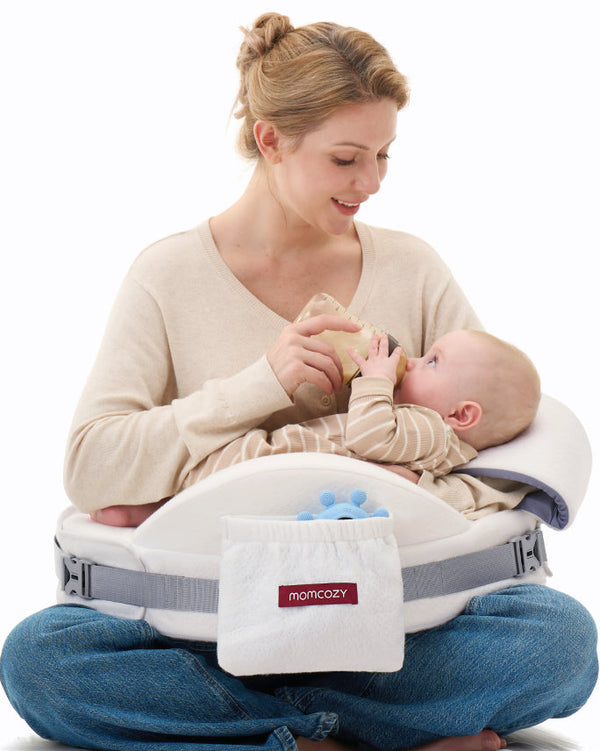
The Momcozy Adjustable Nursing Pillow comes with independent zippers for the outer cover and liner and a removable filling. These features are not enough to tell you how much filling to remove, or if that will even fix your issue. Only ever follow the instructions for your model that are provided with it, before attempting any allowed modification.
Do not remove any filling while your baby is using it, and do not try to guess the required amount of filling. If you are not sure whether the issue is with the height, design, or mobility, describe what you have experienced and get in touch with the manufacturer to ask about your model.

Check Condition and Correct Cover Assembly
Was the sliding there from the beginning, or did it develop after the cover was washed, a part was replaced, or the pillow was stored? The timing is a clue to follow up on, but not proof of causation.
What changed before the sliding started?
With the pillow empty, check the following:
- Seams and fasteners: Look for visible damage. Do not tug or strain parts to test them.
- Cover assembly: If the cover has been taken off, check that it matches your model and reinstall it according to the manufacturer’s instructions.
- Replacement parts: Check that any changed component is approved for your model.
A cover fitting over the pillow doesn’t automatically mean it’s compatible. Follow your model’s own care and assembly instructions rather than borrowing another brand’s directions.
If you find a split seam, broken fastener, or defective part, stop using the pillow and contact the manufacturer. Do not sew on a strap, add non-approved hardware, cut the fabric, or attempt to fix it on your own.
If all seems in order but the pillow still works in another way, request the manufacturer confirm the right parts and assembly procedures. Don’t assume the fabric itself caused the movement.
Decide Whether to Reset, Get Help, or Choose a Different Fit
After checking the pillow’s fit, attachment, setup, and condition, decide what to do based on any remaining issues. A replacement may not be necessary.
Match the next step to the unresolved issue
- Stay with your current arrangement if the pillow stays put as directed and you continue to be able to hold your baby while feeding.
- Contact the manufacturer for help if you’re not sure how to use an attachment, if parts are broken or incorrect, or if the pillow is shifting too much for your comfort even after making the allowed adjustments.
- Try a different fit if your current one can’t sit as directed on your body, or with an allowed seated arrangement.
If your particular fit issue requires an adjustable adult strap or the ability to remove padding, the Momcozy Adjustable Nursing Pillow includes these options. Try it on and read the instructions for use before you choose it, as neither feature guarantees the pillow won't slide around. Don’t assume the MaxSupport has the same adjustment options.

Moving from troubleshooting to shopping? For a side-by-side overview of nursing pillow designs and features, see compare nursing pillow options. For a closer look at models within Momcozy’s range, explore Momcozy nursing pillow options. Still not sure if you even require a pillow? Here we discuss whether you need a breastfeeding pillow.
An adult strap is not an infant restraint or permission to feed hands-free. Until then, just keep supporting your infant and don’t lean on broken pieces.
Frequently Asked Questions
Can I add an anti-slip mat under the pillow?
Use a mat or grip aid only if the manufacturer says it works with your exact model. If you’re unsure, follow the original instructions and contact customer support.
Can I replace a missing belt with a generic strap?
No. Ask the manufacturer for a model-specific approved alternative. If a vital component is lost or damaged, stop using that arrangement until the issue is resolved. Do not use an adult strap to support your baby.
Can another caregiver use the same pillow without changing anything?
Not always. Caregivers must ensure the pillow is the right size and the adjustment instructions are followed. When in doubt, contact the manufacturer.
Do the same checks apply during bottle feeding?
Follow your model’s instructions for permitted feeding methods and keep supporting your baby. Don’t use a pillow to hold up a bottle, and never leave your baby alone with one. Keep nursing pillows away from sleep spaces. For tips on positioning and feeding, learn how to use a nursing pillow.
Conclusion
If your nursing pillow won’t stay in place, first check the model and work out whether it’s sliding or flattening. Review the fit, fastening method, your seating position, and the pillow’s condition using the manufacturer’s guidance. If it still moves after adjustments the instructions allow, get in touch with the manufacturer. If your pillow won’t stay in the recommended position, try another feeding setup. Keep a hand on your baby throughout the feed, and stop using any parts that are cracked, worn, or otherwise damaged. Tightening the straps or buying a replacement pillow may not always solve the problem.